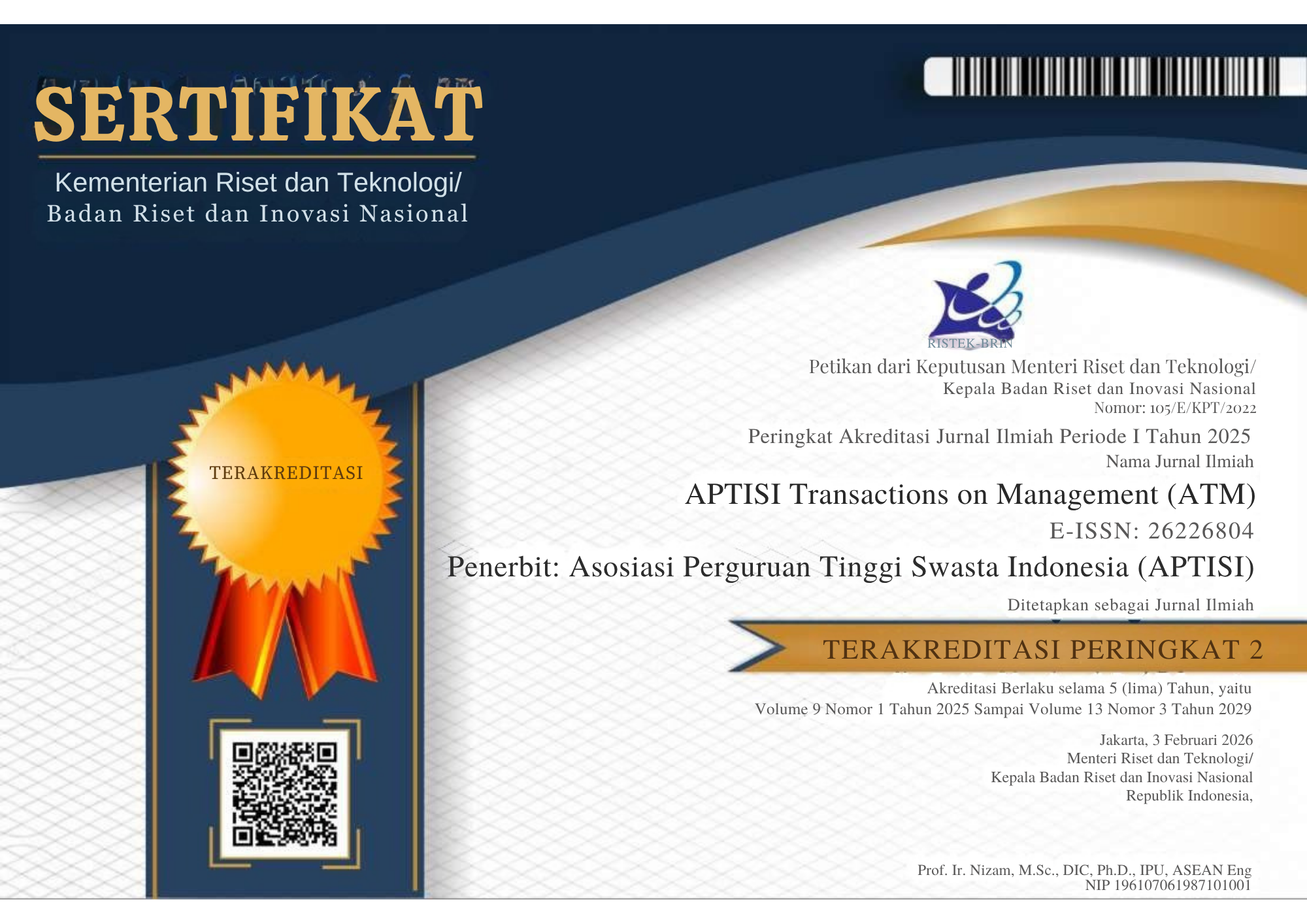
Equity and Government Bond Relationship in Indonesia During Covid Pandemic
DOI:
https://doi.org/10.33050/atm.v10i2.2619Keywords:
Government Bonds, Covid-19 Pandemic, Liquidity Risk, International RiskAbstract
This study extends prior Covid-19 finance literature by examining the dynamic relationship between Indonesian equity returns and sovereign benchmark bond returns using daily data across two pandemic waves. Unlike previous studies focusing primarily on developed markets or conventional flight-to-safety behavior, this study provides evidence that government bonds in emerging markets may temporarily exhibit equity-like risk characteristics during pandemic-induced fiscal stress. Specifically, the findings show that equity market performance is positively correlated with government bond returns in Indonesia during the two waves of the Covid 19, as opposed to the findings from previous studies when there were financial crises, and also the results show negative correlation between the government bond return and the spread of the Credit Default Swap. Furthermore, this study examines the impact of the Covid pandemic to the local Indonesian long-term and medium-term benchmark bonds after applying the international risk factor variable to the model. The results show shifting investors’ attention from the international risk factors to the local risk factors in both medium and long tenor of the bonds during the pandemic period. Overall, this study highlights how pandemic-induced fiscal uncertainty alters stockbond dynamics in emerging markets and challenges conventional safe-haven assumptions regarding sovereign bonds.
Downloads
References
[1] B. Prananta and C. Alexiou, “Exchange rates, bond yields and the stock market: nonlinear evidence of indonesia during the covid-19 period,” Asian Journal of Economics and Banking, vol. 8, no. 1, pp. 83–99, 2024.
[2] B. Rawat, P. A. Sunarya, and V. T. Devana, “Digital marketing as a strategy to improve higher education promotion during the covid-19 pandemic,” Startupreneur Business Digital (SABDA Journal), vol. 1, no. 2, pp. 114–119, 2022.
[3] V. Moutinho, L. Almeida, M. Neves, and J. Monteiro, “Dynamic cross hedging, conditional comovements in commodities and financial markets during subprime and sovereign debt crisis: Evidence from china and g7 countries,” Review of Financial Economics, vol. 43, no. 3, pp. 261–285, 2025.
[4] T. L. Kallenos, P. Papakyriakou, A. Sakkas, and Z. Taoushianis, “Tests of global flights to safety with us financial firm bankruptcy announcements,” European Financial Management, vol. 31, no. 3, pp. 1170–1194, 2025.
[5] N. P. L. Santoso, R. A. Sunarjo, and I. S. Fadli, “Analyzing the factors influencing the success of business incubation programs: A smartpls approach,” ADI journal on recent innovation, vol. 5, no. 1, pp. 60–71, 2023.
[6] Y. Zhou, D. Teresien˙e, G. Keliuotyt˙e-Staniul˙enien˙e, R. Kanapickiene, R. K. Dong, and A. Kaab Omeir, “The impact of covid-19 pandemic on government bond yields,” Frontiers in Environmental Science, vol. 10, p. 881260, 2022.
[7] M. Siahaan, R. Sunarjo, R. Sebastian, and S. Wahid, “The role of natural language processing in enhancing chatbot effectiveness for e-government services,” Journal of Computer Science and Technology Application, vol. 2, no. 1, pp. 65–74, 2025.
[8] S. Ullah, “Impact of covid-19 pandemic on financial markets: A global perspective,” Journal of the Knowledge Economy, vol. 14, no. 2, pp. 982–1003, 2023.
[9] M. K. Brunnermeier, S. Merkel, and Y. Sannikov, “Safe assets,” Journal of Political Economy, vol. 132, no. 11, pp. 3603–3657, 2024.
[10] D. Marina, N. K. Pandjaitan, N. Hasanah, and G. P. Cesna, “Analysis of lifestyle and consumer attitude towards intention to purchase a personal car during pandemic,” APTISI Transactions on Management (ATM), vol. 7, no. 1, pp. 15–34, 2023.
[11] G. C. Montes and J. Costa, “Effects of fiscal credibility on sovereign risk: evidence using comprehensive credit rating measures,” International Journal of Emerging Markets, vol. 17, no. 3, pp. 858–888, 2022.
[12] V. V. Febiandini and M. S. Sony, “Analysis of public administration challenges in the development of artificial intelligence industry 4.0,” IAIC Transactions on Sustainable Digital Innovation (ITSDI), vol. 4, no. 2, pp. 164–168, 2023.
[13] D. Yadav, “Impact of the covid-19 pandemic on macroeconomic indicators: a comparative study of developed and developing countries,” in The Impact of the Covid-19 Pandemic on People and Their Lives. Routledge India, 2023, pp. 207–229.
[14] S. Purnama, C. S. Bangun, A. R. S. Panjaitan, and S. T. Sampoerna, “The effect of digitalization on culinary msmes on increasing sales turnover during covid 19 pandemic,” Aptisi Transactions on Technopreneurship (ATT), vol. 4, no. 1, pp. 58–67, 2022.
[15] N. Benlagha and W. Hemrit, “Responses of stock market volatility to covid-19 government interventions: evidence from asian emerging stock markets,” Review of Behavioral Finance, vol. 17, no. 2, pp. 342–364, 2025.
[16] A. Erica, S. Wulandari, and R. Widayanti, “Data security transformation: The significant role of blockchain technology,” Blockchain Frontier Technology, vol. 3, no. 2, pp. 107–112, 2024.
[17] L. Diaz and G. Collin, “Sudden stops in capital inflows: Global drivers, domestic risks, and macroeconomic consequences in emerging markets,” Journal of Business and Economic Options, vol. 8, no. 2, pp, 10–19, 2025.
[18] A. Abudaqa and I. Noburu, “Optimizing digipreneurship in the growth of the digital millennial creative economy ecosystem,” Startupreneur Business Digital (SABDA Journal), vol. 4, no. 1, pp. 24–34, 2025.
[19] G. Gorton and G. Ordonez, “The supply and demand for safe assets,” Journal of Monetary Economics, vol. 125, pp. 132–147, 2022.
[20] E. Bouri and N. Jalkh, “Flight-to-safety across time and market conditions,” International Review of Economics & Finance, vol. 94, p. 103363, 2024.
[21] A. K. Badri, J. Heikal, Y. A. Terah, and D. R. Nurjaman, “Decision-making techniques using lstm on antam mining shares before and during the covid-19 pandemic in indonesia,” APTISI Trans. Manag, vol. 6, no. 2, pp. 167–180, 2022.
[22] T. Takaishi, “Impact of the covid-19 pandemic on the financial market efficiency of price returns, absolute returns, and volatility increment: Evidence from stock and cryptocurrency markets,” Journal of Risk and Financial Management, vol. 18, no. 5, p. 237, 2025.
[23] A. Ganchev, “Investment characteristics of indonesian government bond market during the covid-19 pandemic,” in Ganchev, A.(2022). Investment Characteristics of Indonesian Government Bond Market During the COVID-19 Pandemic. Proceedings from 12th International Scientific Conference “Business and Management, 2022, pp. 12–13.
[24] T. Bratis, G. P. Kouretas, N. T. Laopodis, and P. Vlamis, “Sovereign credit and geopolitical risks during and after the emu crisis,” International Journal of Finance & Economics, vol. 29, no. 3, pp. 3692–3712, 2024.
[25] S. Watini, H. Latifah, D. Rudianto, and N. A. Santoso, “Adaptation of digital marketing of coffee msme products to digital transformation in the era of the covid-19 pandemic,” Startupreneur Business Digital (SABDA Journal), vol. 1, no. 1, pp. 19–33, 2022.
[26] N. Stoupos and A. Kiohos, “Euro area: towards a european common bond?–empirical evidence from the sovereign debt markets,” JCMS: Journal of Common Market Studies, vol. 60, no. 4, pp. 1019–1046, 2022.
[27] Y. Sudaryo, D. Hamdani, N. A. Sofiati, D. H. N. Sipahutar, and S. Sutisna, “Assessing the drivers of Financial Distress in indonesian rattan smes through digital and financial perspectives,” Aptisi Transactions on Technopreneurship (ATT), vol. 7, no. 3, pp. 904–913, 2025.
[28] E. Ciapanna, S. Mocetti, and A. Notarpietro, “The macroeconomic effects of structural reforms: an empirical and model-based approach,” Economic Policy, vol. 38, no. 114, pp. 243–285, 2023.
[29] T. J. Putnin¸ ˇs, “Free markets to fed markets: How modern monetary policy impacts equity markets,” Financial Analysts Journal, vol. 78, no. 2, pp. 35–56, 2022.
[30] S. Purnama, C. S. Bangun, and E. P. Mahadewi, “Predicting consumer purchase intention in personal shopper services using big data analytics and sem,” International Journal of Cyber and IT Service Management (IJCITSM), vol. 5, no. 1, pp. 105–119, 2025.
[31] J. Dhokotera, Sovereign credit risk changes and financial market returns: evidence from African emerging economies. University of Johannesburg (South Africa), 2024.
[32] A. Brixton, J. Brooks, P. Hecht, A. Ilmanen, T. Maloney, and N. McQuinn, “A changing stock-bond correlation: Drivers and implications.” Journal of Portfolio Management, vol. 49, no. 4, 2023.
[33] I. Sembiring, D. Manongga, U. Rahardja, and Q. Aini, “Understanding data-driven analytic decision making on air quality monitoring an empirical study,” Aptisi Transactions on Technopreneurship (ATT), vol. 6, no. 3, pp. 418–431, 2024.
[34] I. Katsampoxakis, “Ecb’s unconventional monetary policy and spillover effects between sovereign and bank credit risk,” EuroMed Journal of Business, vol. 17, no. 2, pp. 218–245, 2022.
[35] P. H. P. Tan, M. Tukiran, and D. Wuisan, “Innovation practices and external support for msme performance and survival in indonesia,” International Journal of Cyber and IT Service Management (IJCITSM), vol. 5, no. 2, pp. 120–133, 2025.
[36] M. O. Rieger and M. Wang, “Trust in government actions during the covid-19 crisis,” Social Indicators Research, vol. 159, no. 3, pp. 967–989, 2022.
[37] C. Alba, G. Cuadra, J. R. Hernandez, and R. Ibarra, “Capital flows to emerging economies and global risk aversion during the covid-19 pandemic,” International Journal of Finance & Economics, vol. 29, no. 3, pp. 2804–2836, 2024.
[38] A. Bist, N. Zakaria, N. Anwar, G. Jacqueline, and L. MING, “Future of work: How digital tools are transforming human resource management,” APTISI TRANSACTIONS ON MANAGEMENT: iLearning Journal Center, vol. 8, no. 3, pp. 213–220, 2024.
[39] G. R. Duffee, “Macroeconomic news and stock–bond comovement,” Review of Finance, vol. 27, no. 5, pp. 1859–1882, 2023.
[40] N. Carnot and S. Pamies, “Government bond spreads in the euro area,” The Economists’ Voice, vol. 20, no. 1, pp. 103–110, 2023.
[41] H. Nufus, B. Hermansah, R. T. H. Safariningsih, S. Wibowo, and N. Rangi, “Blockchain for enhancing data traceability in digital supply chain management,” Blockchain Frontier Technology, vol. 5, no. 2, pp. 194–206, 2026.
[42] C. Proenc¸a, M. Neves, J. C. Dias, and P. Martins, “Determinants of sovereign debt ratings in clusters of european countries–effects of the crisis,” Journal of Financial Economic Policy, vol. 14, no. 3, pp. 403–427, 2022.
[43] B. K. Bintoro, N. Lutfiani, D. Julianingsih et al., “Analysis of the effect of service quality on company reputation on purchase decisions for professional recruitment services,” APTISI Trans. Manag, vol. 7, no. 1, pp. 35–41, 2023.
[44] L. Hu, Z. Wang, S. Hu, W. Shi, S. Wang, and Y. Wang, “A study on the transnational spillover effects of bank risk and sovereign risk–from the perspective of covid-19 epidemic situation,” Frontiers in Public Health, vol. 10, p. 940126, 2022.
[45] N. F. Campos, P. De Grauwe, and Y. Ji, “Structural reforms and economic performance: The experience of advanced economies,” Journal of Economic Literature, vol. 63, no. 1, pp. 111–163, 2025.
[46] M. Nurkanti, U. Rahardja, M. Lubis, and A. A. M. Shukri, “Deep learning-based biology learning with ethnopedagogy and local wisdom to support sustainable development goals,” Jurnal Pendidikan IPA Indonesia, vol. 15, no. 1, 2026.
[47] Organisation for Economic Co-operation and Development (OECD), The Development and Humanitarian Response to the COVID-19 Pandemic in Cambodia 2020–2022. Paris: OECD Publishing, 2023, accessed: 2026-05-20. [Online]. Available: https://www.oecd.org/en/publications/the-development-and-humanitarian-response-to-the-covid-19-pandemic-in-cambodia-2020-2022_216482a4-en.html
[48] S. Y. Karaman, “Covid-19, sovereign risk and monetary policy: evidence from the european monetary union,” Central Bank Review, vol. 22, no. 3, pp. 99–107, 2022.
[49] S. Watini, “New design of tv sekolah prototype as innovative learning media for early childhood education,” International Journal of Cyber and IT Service Management (IJCITSM), vol. 5, no. 1, pp. 93–104, 2025.
[50] C. Gonz´alez-Velasco, M. Garc´ıa-L´opez, and M. Gonz´alez-Fern´andez, “Does sovereign risk impact banking risk in the eurozone? evidence from the covid-19 pandemic,” Finance Research Letters, vol. 47, p. 102670, 2022.
[51] A. Drakos and G. Moratis, “The impact of covid-19 on sovereign contagion,” Journal of Financial Stability, vol. 70, p. 101189, 2024.
[52] A. Ganchev, “How the covid-19 pandemic affected the investment characteristics of the indonesian government bond market,” International Journal of Economics and Business Research, vol. 29, no. 3-5, pp. 213–232, 2025.
[53] M. F. Nugraha, “Examining us monetary spillover to indonesian local currency government bonds in volatile periods,” ADBI Working Paper, Tech. Rep., 2023.
[54] U. Rahardja, Q. Aini, R. Supriati, and M. A. Al Hafiz, “Optimizing digital promotional graphic design strategies using the aida model,” ADI Journal on Recent Innovation (AJRI), vol. 7, no. 2, pp. 220–230, 2026.
Downloads
Published
Issue
Section
License
Copyright (c) 2026 Gracia Shinta S. Ugut, Liza Handoko, Kristina Vaher

This work is licensed under a Creative Commons Attribution-ShareAlike 4.0 International License.
.png)