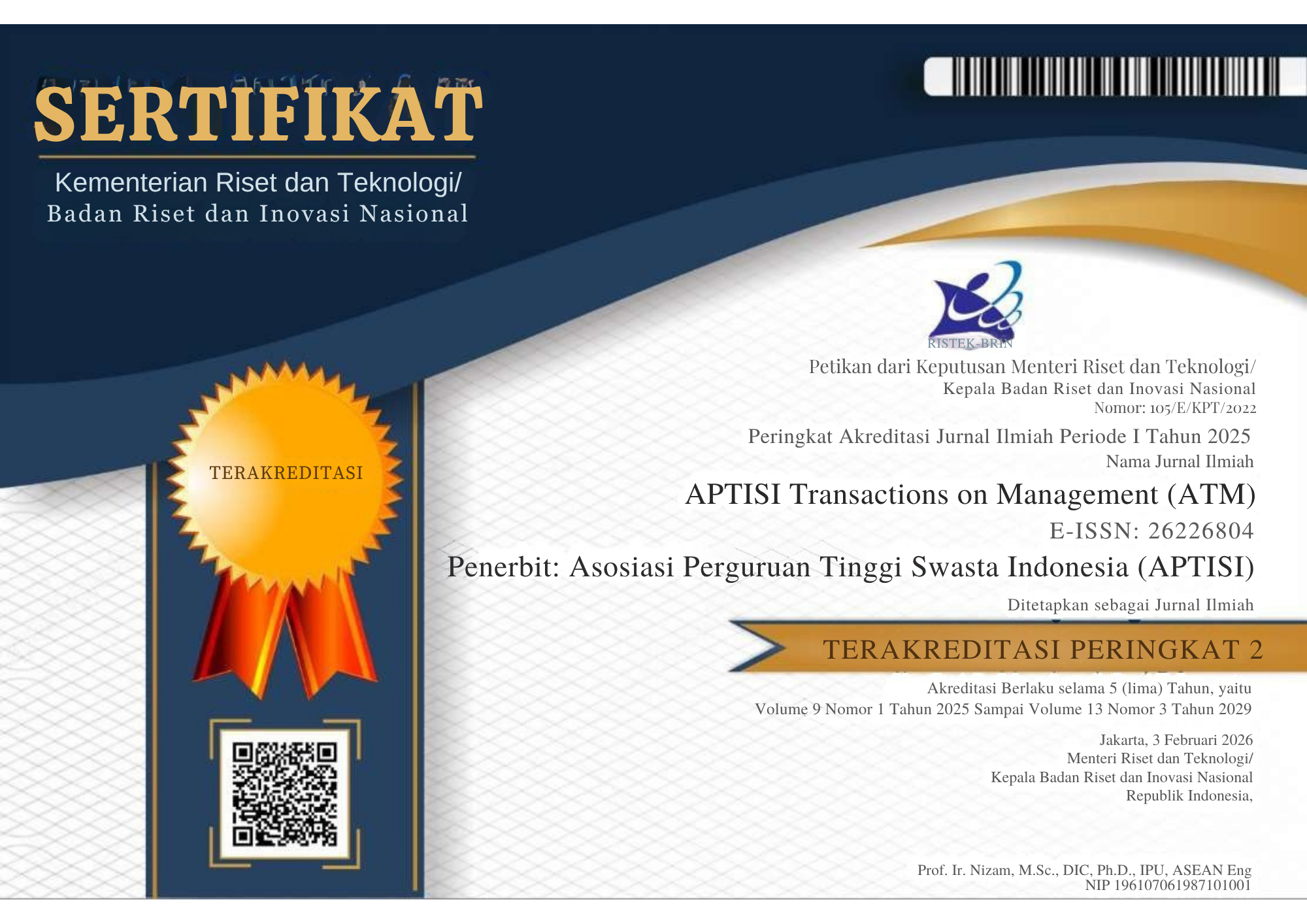
| ACCREDITED |
|---|
|
|
Types of Manuscripts
APTISI Transactions on Management (ATM Journal) welcomes original scholarly manuscripts that contribute to the advancement of management theory, technological innovation, digital transformation, and organizational development. The journal provides an academic platform for researchers, academics, practitioners, and policymakers to present theoretical insights, empirical findings, and practical solutions to contemporary management challenges. Submissions must align with the journal's aims and scope and demonstrate a clear contribution to technology innovation management, digital transformation in organizations, human resource management and workplace digitalization, risk management in the era of fintech and blockchain, or sustainable and environmentally conscious management strategies.
1. Original Research Articles
Full-length articles presenting original empirical or theoretical research in management, organizational development, technology innovation, and digital transformation. Manuscripts should clearly articulate the research problem, objectives, theoretical foundations, methodology, findings, and contributions to existing scholarly knowledge.
Research may employ quantitative, qualitative, or mixed-method approaches. Submissions should demonstrate methodological rigor, analytical depth, and a clear explanation of their theoretical and practical implications. Relevant topics include organizational performance, strategic management, digital leadership, technology adoption, human resource management, workplace digitalization, fintech, blockchain, risk management, and sustainable management practices.
2. Case Study Articles
Articles providing an in-depth analysis of management practices, organizational challenges, technological implementations, or strategic initiatives in real-world business, industrial, governmental, or institutional settings. Manuscripts should explain the organizational context, problems addressed, management strategies or interventions, analytical methods, outcomes, and lessons learned.
Case studies may examine digital transformation initiatives, technology adoption, organizational restructuring, human resource development, digital workplace practices, financial technology implementation, risk mitigation, or sustainability initiatives. Submissions should provide evidence-based analysis and transferable managerial insights while acknowledging contextual limitations and implications for management practice.
3. Technology Innovation and Applied Research Articles
Articles presenting the design, development, implementation, and evaluation of innovative technologies, digital applications, information systems, or technology-enabled solutions that address significant management and organizational challenges. Manuscripts should identify the problem being addressed, explain the proposed solution and development methodology, describe implementation and evaluation procedures, and report the resulting evidence.
Relevant contributions may include artificial intelligence, business intelligence, Internet of Things, blockchain, fintech, digital platforms, enterprise information systems, automation, data analytics, and other emerging technologies that support managerial decision-making and organizational innovation. Technical contributions should be accompanied by evidence of effectiveness, usability, operational improvement, risk reduction, or organizational value, together with meaningful implications for management and professional practice.
4. Review Articles
Articles critically synthesizing existing scholarly literature on management, technological innovation, digital transformation, organizational development, and related areas within the journal's scope. Reviews may employ systematic literature review, bibliometric analysis, scoping review, meta-analysis, or other clearly defined and academically rigorous review methodologies, as appropriate to the research objectives.
Manuscripts should establish a clear review objective, explain the literature search and selection procedures, specify relevant inclusion and exclusion criteria where applicable, critically evaluate the selected studies, and identify research trends, theoretical developments, knowledge gaps, and future research directions. Review articles should offer an original synthesis, conceptual advancement, or integrative framework rather than merely summarizing previously published research.
5. Mini-Reviews and Scholarly Commentaries
Concise scholarly articles presenting focused critical assessments of emerging research, contemporary management issues, or developments in technology-driven organizational change. Contributions may address digital leadership, workplace digitalization, fintech and blockchain risks, responsible technology adoption, sustainable management, or emerging challenges in organizational strategy.
Mini-reviews should synthesize a clearly defined body of relevant scholarly literature and identify important developments, unresolved issues, and opportunities for future research. Scholarly commentaries may critically discuss new management concepts, technological developments, organizational policies, or regulatory and professional challenges. All submissions must be supported by credible scholarly evidence, present a coherent academic argument, and offer meaningful implications for researchers, practitioners, or policymakers. Personal opinions, promotional material, and unsupported claims are not considered sufficient scholarly contributions.
General Submission Requirements
All manuscript types must comply with the journal's Author Guidelines, official article template, and Publication Ethics policies. Submissions must be original, must not have been previously published, and must not be under consideration by another journal.
Manuscripts must comply with ATM Journal's official language policy and formatting requirements. Authors should maintain internationally recognized standards of academic writing, research integrity, methodological transparency, and scholarly communication. The applicable language and formatting requirements should be verified against the journal's current official author guidelines.
Authors are expected to demonstrate the novelty, significance, and relevance of their research to the journal's aims and scope. Manuscripts must provide sufficient methodological and analytical evidence and clearly explain their contributions to management theory, technology innovation management, digital transformation, organizational development, or sustainable management practices. Where applicable, managerial implications should translate research findings into actionable recommendations for organizational leaders, managers, human resource professionals, business practitioners, and policymakers.
ATM Journal encourages authors to discuss the relevance of their research to the United Nations Sustainable Development Goals (SDGs) where supported by the research objectives, methods, and findings. Relevant goals may include SDG 4 (Quality Education), SDG 8 (Decent Work and Economic Growth), SDG 9 (Industry, Innovation and Infrastructure), SDG 12 (Responsible Consumption and Production), and SDG 13 (Climate Action). SDG alignment should be substantive and evidence-based rather than included merely for presentation purposes.
Authors must appropriately acknowledge individual contributions, funding sources, and institutional support; disclose potential conflicts of interest; and report ethical approval and participant consent where applicable. The use of generative artificial intelligence or AI-assisted technologies must comply with ATM Journal's applicable Generative Artificial Intelligence (GenAI) Policy, including transparency and disclosure requirements where required by the journal.
Submissions should demonstrate academic originality, analytical rigor, sound research methods, and clear relevance to the journal's focus and scope. Manuscripts consisting solely of descriptive reports, promotional content, unsupported opinions, or technical documentation without scholarly analysis and meaningful contributions to management knowledge or practice fall outside the intended manuscript categories.
All manuscripts are subject to initial editorial screening and, where appropriate, a double-blind peer-review process in accordance with ATM Journal's editorial policies. Publication decisions are based on relevance to the journal's scope, originality, methodological quality, research integrity, clarity of presentation, and contributions to scholarly knowledge and professional practice.
.png)